7 Proven Full Body Home Workout Exercises for Beginners (Step-by-Step Guide)
full body home workout for beginners at home
You Don’t Need a Gym to Get Fit
Getting fit at home is much easier than most people think.
You do not need a gym. You do not need any equipment. And, most importantly, you do not even need to be in shape to begin with.
So, let me ask you a question, a question that requires a truthful answer from your heart.
Have you ever wanted to start getting fit, but had no idea how to begin? Have you ever thought fitness was reserved for those gym-goers and fitness gear enthusiasts?
If your answer to both questions is a resounding yes, then congratulations! You are reading an article written especially for you.
You just need a little space on your floor, a little time, and a plan that makes sense and makes sense to your brain and your body.
And that is exactly what we are going to do here. We are going to give you seven exercises, explained step by step, and written in such a way that even a complete newbie from any part of the world can understand and follow through with ease.
If you are a complete newbie and want to learn how to begin, check out our article on how to start a workout at home for beginners.
According to one of the top fitness organizations in the world, doing a full-body workout two to three times a week is one of the best things you can do for your overall health and fitness.
That’s it. No complicated program. No expensive gym membership. Just basic movement, done regularly.
You don’t have to be perfect. You just have to begin. Every fitness role model you’ve ever had in your life began where you are today.
Table Of Contents
- You Don’t Need a Gym to Get Fit
- Why a Full Body Home Workout for Beginners Actually Works
- Before You Start Always Warm Up (5 Minutes)
- Full Body Home Workout for Beginners 7 Easy Exercises
- Exercise 1 — Bodyweight Squat
- Exercise 2 — Knee Push-Up
- Exercise 3 — Glute Bridge
- Exercise 4 — Plank
- Exercise 5 — Reverse Lunge
- Exercise 6 — Superman Hold
- Exercise 7 — Mountain Climber
- Your Weekly Plan Simple and Easy to Follow
- What Equipment Do You Need?
- Four Mistakes That Slow Down Your Progress
- The Most Important Thing of All
- What Results Will You See and When?
- What Should You Eat? Simple Nutrition Tips
- A Quick Note on Extra Support
- Start Right Now Here’s What to Do
- Frequently Asked Questions
- References
Why a Full Body Home Workout for Beginners Actually Works
Think about it this way.
When you first learned how to drive a car, did you just work on how to turn left? No, you learned how to drive a car, including how to turn left, how to steer, how to check your mirrors, and how to use your brakes, all at once. Your entire body learned how to drive a car.
Well, exercise is just like that.
When you are a beginner, your entire body has to learn how to exercise. Your legs, your arms, your back, and your stomach all have to work together. A full body workout exercises your entire body, all at once.
That means better results in less time.
Scientists found that beginners who worked on their entire body two or three times a week became stronger much faster than those who worked on one body part at a time.
So, keep it simple. Work on your entire body. Show up three times a week. That is the smartest way to start.
Before You Start Always Warm Up (5 Minutes)
Please don’t skip this part.
I know this part is boring. You know you want to get started right away and start doing the exercises. But please don’t skip this part. Warming up is one of the most important things you can do for your body.
Here is a simple way to think about this. Muscles are like cold butter. You know, cold butter that you take directly from the fridge. If you try to spread cold butter, it tears. But if you warm up the butter a little, then you can spread it smoothly. Your muscles are just like that too. Five minutes is all it takes. Here is your warm up:
✔ Marching in place – 1 minute. Lift your knees and swing your arms. Start slow and get a little faster as you go.
✔ Arm circles – 30 seconds forward and 30 seconds backward. Make big, smooth, slow circles with your arms.
✔ Hip circles – 30 seconds forward and 30 seconds backward. Put your hands on your hips and make big, smooth, slow circles with your hips.
✔ Leg swings – 10 for each leg. Hold a wall with one hand. Swing one leg forward and backward like a pendulum.
✔ Slow half squats – 10 times. Go down only half way.
Done! Your body is warm and ready to go! Now, let’s get to work!
Full Body Home Workout for Beginners 7 Easy Exercises
Do these exercises one after the other. Rest for 30 to 60 seconds between each of these exercises. After you finish these 7 exercises, you can say you have just completed your first full body workout!
You can also check out the 10 Easy Home Workouts for Beginners article for more exercises with no equipment at all!
Exercise 1 – Bodyweight Squat
Legs, Bottom, Core 3 sets of 10 to 12 reps
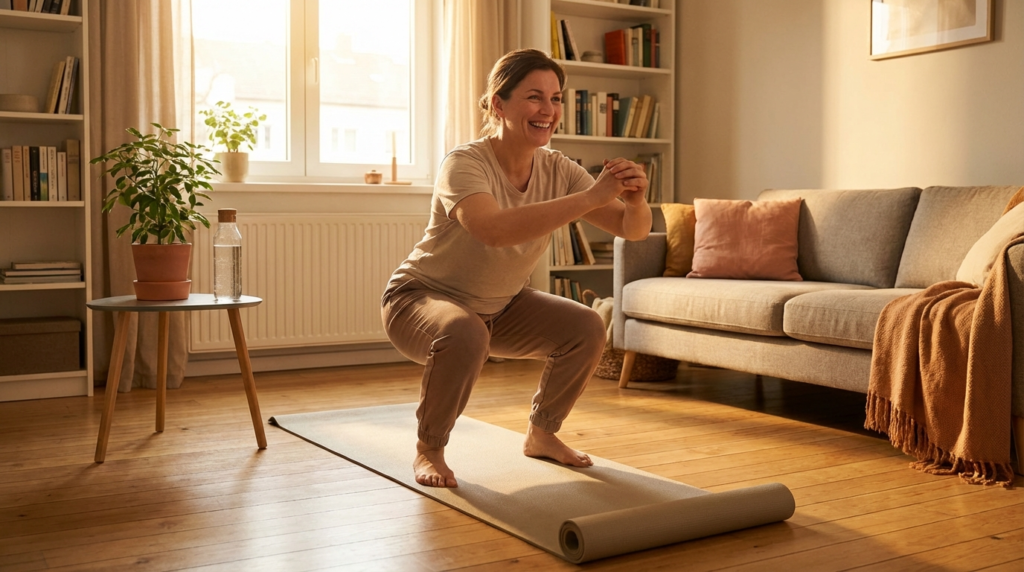
Squat is the single most important exercise you can learn as a beginner. This is because squat works the biggest muscles of the body simultaneously! So, master squat and everything else is a breeze!
Here’s how you can do the squat:
Stand up straight with feet shoulder-width apart and toes slightly pointed out.
Slowly push your hips back as though you are sitting down on a low chair placed behind you.
Keep your head up and back straight and do not lean forward.
Go down as low as you can so that your thighs are at the same level as the ground.
Now push back up with your heels and squeeze your bottom at the top of the squat.
That’s one repetition.
Common mistake: Your knees go inward while you are standing up straight! To avoid this, push your knees out while you are standing up straight! Think of the effort of pushing the ground apart with your feet!
When you are ready try: Pause squat. Hold the low position for 2 full seconds before standing up. Simple change but much harder.
Exercise 2 — Knee Push-Up
Works: Chest, Shoulders, Arms, Core
Sets : 3
Reps : 8-10
The push-up works the upper body just as the squat works the lower body. The knee push-up is the best push-up exercise for beginners. Nothing is wrong with starting here. Everyone starts here.
Here is how to do the push-up:
Get down on your hands and knees. Place your hands slightly wider than your shoulders.
Bring your knees back so your body is in a straight line from knees to head.
Pull in your stomach muscles. Do not let your hips sag down or stick out.
Slowly bend your elbows, lowering your body toward the floor. Keep your elbows at a 45-degree angle, not pointing out to the side.
Straighten your arms to go back up to the starting position. This is one repetition.
Common mistake: Elbows pointing out to the side. This is very bad stress on the shoulder joints. Keep them at a 45-degree angle to your body.
When you are ready try: Full push-up on the floor with feet extended behind you. Give yourself 3 to 4 weeks on the knee push-up.
Exercise 3 — Glute Bridge
Works: Bottom, Back of Legs, Lower Back 3 sets of 12 to 15 reps
Here is something most beginners do not know. Most people have a very weak bottom from sitting in a chair all day. This weakness causes lower back pain, poor posture, and slow progress in other exercises.
This exercise fixes all of that directly.
Here is how to do it:
- Lie flat on your back on the floor. Bend your knees. Place your feet flat on the floor hip-width apart.
- Put your arms flat by your sides with palms facing down.
- Take a breath in. As you breathe out squeeze your bottom muscles as hard as you can and push your hips up toward the ceiling.
- At the top your body should make a straight line from your shoulders to your knees. Hold this position for one full second.
- Slowly lower your hips back down to the floor. Do not drop them. Control the movement all the way down.
Common mistake: Feeling this exercise in your lower back instead of your bottom. This means your back is doing the work instead of your bottom. Fix it by moving your feet slightly closer to your hips and really focusing on squeezing your bottom muscles hard at the top.
When you are ready try: Single leg glute bridge. Lift one leg straight off the floor and do all your reps on one leg only. Then switch to the other leg. This is much harder but excellent for building real strength.
Exercise 4 – Plank
3 sets of 20 to 30 seconds
Works: Stomach, Core, Shoulders, Bottom
This is an extremely challenging exercise, but it is also very effective.
It is the most important exercise you can do to strengthen the core.
Your entire abdominal region is working as one.
This is how you do the plank exercise:
Put forearms flat on the floor.
Stretch legs back, balancing on toes and forearms.
Tighten stomach as if someone is about to poke you in the stomach.
Squeeze bottom.
Your body should be in a straight line from the heels to the back of the head. Your hips should not be sagging. Your backside should not be sticking up.
Continue to breathe normally. Look down at the floor in front of you. Wait until the time is up.
Common Mistakes:
Your hips are sagging down towards the floor because you are getting tired. The second your hips begin to drop, the plank is no longer working and is now working against you, hurting your back. Take a break and rest.
Ready to move on? Plank Shoulder Taps:
While in the plank position, lift one arm and tap the opposite shoulder. Alternate arms and shoulders, moving very slowly and carefully.
Exercise 5 – Reverse Lunge
Muscles worked:
Front of Legs, Bottom, Balance
2 sets of 8 repetitions each leg
The reverse lunge is great because you are only using one leg at a time. The reverse lunge will give you balance and coordination that squats will not. The reverse lunge is much easier on the knees compared to the forward lunge.
This is how you do the reverse lunge:
Stand up as tall as you can. Feet are shoulder-width apart. Your hands are on your hips or by your sides.
Step backwards with your right foot as far as you can. Land softly on the ball of your right foot.
Slowly lower the back knee down towards the ground. But only go down as far as you can without touching the ground with the back knee.
Your front leg is now at a 90-degree angle. Your thigh is parallel to the ground.
Stand back up, using the front heel as the take-off point. Repeat 8 times and then switch legs.
Common Mistakes:
You are leaning forward as you are lowering down into the reverse lunge position. Keep your back and head up and straight. If you are having trouble balancing, lightly grasp the back of the wall with the back of one hand. That is totally fine.
When you are ready try: Walking lunge. Instead of stepping back to the start, step forward into the next lunge. Continue moving forward like you are walking in slow motion.
Exercise 6 — Superman Hold
Works: Lower Back, Bottom, Upper Back 2 sets of 10 reps
Most people do not even train this part of their body, and therefore they wonder why they are in pain here. This exercise takes care of this problem for them. This exercise also helps to train your bottom and upper back at the same time.
Here is how to do this exercise:
Lie on your stomach on the floor with your arms stretched out in front of you, and your legs stretched out behind you.
Breathe in, and when you exhale, raise your arms, chest, and legs off the floor.
Squeeze your bottom and your upper and lower back muscles.
Hold this position for 2 seconds.
Keep your neck muscles relaxed and look down toward the floor, do not strain your neck to look forward.
Slowly return your arms, chest, and legs to the floor.
One repetition.
Common mistake: Straining your neck forward to look forward. This can hurt your neck muscles a great deal, and we want to avoid this problem.
When you are ready try: Alternating superman. Only raise your right arm and your left leg, and then your left arm and your right leg. This takes a bit more balance, but it is a powerful exercise.
Exercise 7 — Mountain Climber
Works: Stomach, Core, Hips, Cardio 3 sets of 20 seconds
This exercise is a two-in-one deal. It works out your core and gets you a good workout on the cardiovascular level too. By the time you are done with the 20 seconds of the exercise, you will know you are doing it everywhere.
Here’s how you can do the exercise:
Get into a full plank position with straight arms and legs and the hands directly under the shoulders.
Tighten up your stomach muscles.
Now push your right knee towards the chest.
Quickly change and repeat the action with the other knee.
Start off slow and get the movement right before you speed up.
Common mistake: The hips are raised up in the air while you are doing the knee movement.
When you are ready to move on to the next level of the exercise:
Faster mountain climbers.
Get the movement right first and then speed up the movement.
30 seconds of the mountain climber at a fast pace.
Your Weekly Plan: Simple and Easy to Follow
This full-body home workout for beginners works out the entire body and can be followed with a simple and easy-to-follow weekly workout routine.
Three days a week is what you need.
Nothing more . Nothing less . Here’s what most people get wrong:
Most people believe that the days they take off are the days they are wasting . Not true . Muscle growth happens when you are resting and not when you are working out.
The workout is just a signal to the muscles and the magic happens when you are resting.
So please do not skip your rest days thinking more is better. It is not.
✔ Monday — Do your full workout. All 7 exercises.
✔ Tuesday — Rest day. A gentle walk is perfect if you feel like it.
✔ Wednesday — Do your full workout.
✔ Thursday — Rest day. Do some light stretching if you feel tight.
✔ Friday — Do your full workout.
✔ Saturday — Optional. Light walk or gentle stretching only.
✔ Sunday — Full rest. You have earned it.
Stick to this for four weeks. Then start adding more reps or cutting rest time between exercises. That is how you keep improving week after week.
Still unsure about how often you should exercise? Then check out this simple guide on how often you should exercise per week.
This home workout for beginners will give you real results you can actually see and feel if you stick to it for the whole four weeks.
What Equipment Do You Need?
Honestly — nothing.
Not a single piece of equipment. All seven exercises can be done using your bodyweight alone. The only space you will need is about six feet by six feet. That is roughly the size of a bathroom.
You can start your workout in your bedroom. In your living room. In your garden. Anywhere you like.
If you want to make things more comfortable over time, an exercise mat is nice to have. However, it is not necessary to get one today. You have everything you need today.
Do not wait for the right equipment. Do not wait for the right day. The right moment is this one.
Four Mistakes That Slow Down Your Progress
These are the four most common mistakes beginners make. Avoid them and you will see results much faster.
Mistake 1 – Skipping the warm-up
Your muscles are stiff and easy to injure when they are cold. Five minutes of warm-up before every workout is not optional. It is mandatory. It protects you and makes your workout more effective.
Mistake 2 – Doing too much too soon
Trying to do daily intense workouts in week one is a recipe for burning out or injuring yourself. Three workouts a week feels like it is not even enough. It is more than enough. Just trust the process.
Mistake 3 – Going too fast
Rushing through your reps to finish your workout quickly is not going to help you at all. In fact, it is counterproductive. It will give you strength, but it will give you bad habits and injuries too.
Mistake 4 – Not writing things down
If you do not know what you did last week, you have no idea how to improve this week. All you need is your notes on your phone or a simple notebook. Write down the date, what you did, and how many reps you did. That is it.
The Most Important Thing of All
It is not what exercises you do.
It is not how long your workout is.
It is not even what you eat.
It is simply showing up.
Scientists who study habits found some interesting things. They learned that it takes about 66 days, or two months, for a behavior to become automatic. Not 21 days, like most people believe. Two months.
So, what does this mean? It means that the first two months will be tough. There will be days when you don’t feel like working out. Days when things get in the way. Days when sitting on the couch will sound much more appealing than working out.
So, what do you do on those days? Remember this one rule:
Never skip two workouts in a row.
Skip one? No worries. Life happens to everyone. But don’t skip the next one. Don’t skip the one after that. Just show up.
Right now, put three reminders on your phone. Title them MY WORKOUT. When that reminder goes off, put your shoes on and begin your warm-up. Just your warm-up. The rest will come after.
What Results Will You See and When?
Here’s what will happen, no hype, no lies, just what will actually happen.
✔ Weeks 1 and 2: Your body will be adapting. You will feel less sore after workouts. Your workouts will be slightly easier by day seven.
✔ Weeks 3 and 4: Your strength will be increasing. You will be doing more repetitions than in week one, and you won’t feel like you’re trying harder. Your nervous system will be adapting.
✔ Weeks 5 to 8 — Visible changes begin to appear. Your clothes fit a little differently. Your posture has improved significantly. People around you may even comment on your transformation.
✔ Weeks 9 to 12 — This is when your transformation really begins to take shape. Real visible changes to your body. You will have much more energy than before. You will be much fitter than you thought you could be when you started your fitness journey.
People who follow a full body workout for beginners plan and stick to a regular workout routine for 12 weeks experience a transformation that they never thought they could achieve.
Don’t just look for weight loss, look for other indicators too. Have you been able to do more pushups than last week? Are stairs much easier? Do you sleep much better? Do you wake up much more refreshed? Yes, these are all real changes, even if they don’t appear to be in front of a mirror.
What Should You Eat? Simple Nutrition Advice
You do not have to follow a complex diet plan. You do not have to starve yourself and eliminate food groups from your diet either. Just follow these three rules and your diet will be perfect for your fitness journey.
Rule 1 — You Need Protein
Protein is what your muscles use to build and repair themselves after a workout. Without enough protein, your muscles won’t be able to fully recover from your workout, and your fitness journey won’t be effective.
Rule 2 — You Should Only Eat Real Food
Rice, oats, bread, potatoes, vegetables, and fruit provide your body with the energy it needs for your workouts and recovery. Real whole foods, most of the time, is all you need. You don’t have to be perfect. Aim for 80 percent real food and be kind to yourself for the rest.
Rule 3 — Drink enough water
Being even one or two percent dehydrated can significantly impact your strength, your energy levels, and your recovery. Drink at least two litres of water per day. More on days when you exercise.
The Academy of Nutrition and Dietetics agrees: “Proper hydration is one of the simplest and most effective ways to enhance your fitness outcomes.”
One More Thing Worth Knowing
For most people, exercise and healthy eating is all you need to achieve fantastic fitness outcomes.
However, for some people, especially over 35, it can be frustrating when after weeks of doing all the right things, your body still doesn’t seem to be responding. It is more common than you might think. It doesn’t mean you are doing anything wrong.
If this is you, some people have found taking a natural supplement can be an added boost to your healthy lifestyle.
One supplement you might like to know about is CitrusBurn. It is made up of plant-based ingredients Seville Orange Peel, Spanish Apple Vinegar, and Himalayan Ginger. It is designed to be an aid to healthy living, not a replacement for it.
To be clear, it is not a shortcut. It is not a magic solution. Nothing replaces regular exercise and healthy food. But for some, it can give their efforts an extra boost.
If you are curious, you can learn more about CitrusBurn here.
Before you start, please talk to your doctor if you are taking any medication or if you have any health condition.
Disclaimer: This section contains an affiliate link. If you purchase through this link, we may earn a small commission at no additional cost to you. Results may vary. This is for information and educational purposes only.
Start Right Now Here Is What to Do
You have read the entire guide. You know the exercises. You have the plan.
Now, there is just one thing to do. Start.
Here are your five steps. Do these right now before closing this page.
Clear a little space on your floor, about six feet by six feet.
Do the five-minute warm-up above.
Do just one round of all seven exercises. One round is your first workout done.
Write down the date today and one sentence about how you felt after doing these exercises.
Set three reminders this week and name them MY WORKOUT.
That is it. You have started.
This full-body workout for beginners is absolutely free. It is right here. It is ready for you. The only thing missing is your first step.
Three months from today, you will look back on this moment and be happy that you started. But only if you start.
Frequently Asked Questions
Q. How many times a week should a beginner work out at home?
A. Three times a week is best. This is because your body is getting enough exercise to improve and enough rest to recover. This is the advice given by the American College of Sports Medicine for beginners.
Q. How long should my workouts be?
A. Twenty to thirty minutes is enough. It is better to have short, regular workouts rather than infrequent workouts. This is especially important for those who are new to exercising.
Q. Do I need any equipment for my workout?
A. No. The exercises require no equipment, just your own body weight. You need a little space on the floor. You don’t need any equipment. You can start your workout today with what you have.
Q. Can my workouts at home help me lose weight?
A. Yes, but don’t forget to eat well too. Your workouts help your body burn more calories. It also helps you build muscles. Muscles help you burn more calories even while you are resting.
Q. Will I be sore after my first workout?
A. Yes, you probably will. But don’t worry. It is okay. It is a good sign. It is a good sign that your muscles are getting stronger. It will go away in two or three days. Taking a walk on your rest day will get rid of the soreness even sooner.
References
WHO — Global Physical Activity Facts (2020) Link: https://www.who.int/news-room/fact-sheets/detail/physical-activity
American College of Sports Medicine — ACSM’s Guidelines for Exercise Testing and Prescription Link: https://acsm.org/education-resources/books/guidelines-exercise-testing-prescription/
Schoenfeld BJ, et al. — Resistance Training Frequency and Muscle Growth (Sports Medicine, 2016) Link: https://pubmed.ncbi.nlm.nih.gov/27102172/
Garber CE, et al. — ACSM Position Stand: How Much Exercise Do You Need? (2011) Link: https://pubmed.ncbi.nlm.nih.gov/21694556/
Lally P, et al. — How Long Does It Take to Form a Habit? (European Journal of Social Psychology, 2010) Link: https://onlinelibrary.wiley.com/doi/abs/10.1002/ejsp.674
Academy of Nutrition and Dietetics — Eating, Exercise and Hydration Link: https://www.eatright.org/fitness/sports-and-performance/fueling-your-workout/eating-and-exercise-5-tips-to-maximize-your-workouts
Lauersen JB, et al. — Exercise Prevents Injury (British Journal of Sports Medicine, 2018) Link: https://bjsm.bmj.com/content/52/24/1557
CDC — Why Physical Activity Matters Link: https://www.cdc.gov/physical-activity/php/about/index.html
Disclaimer: This article is for information and education only. It is not medical advice. Please speak to your doctor before starting any new exercise or eating plan. Some links may be affiliate links if you buy something through them, we may earn a small commission at no extra cost to you. We only mention things we genuinely believe can help you.