20-Minute Home Workout for Beginners — Fast, Simple and Effective
No time to work out? Then why not try the best 20-minute home workout for busy beginners. Read on to learn everything you need to know.
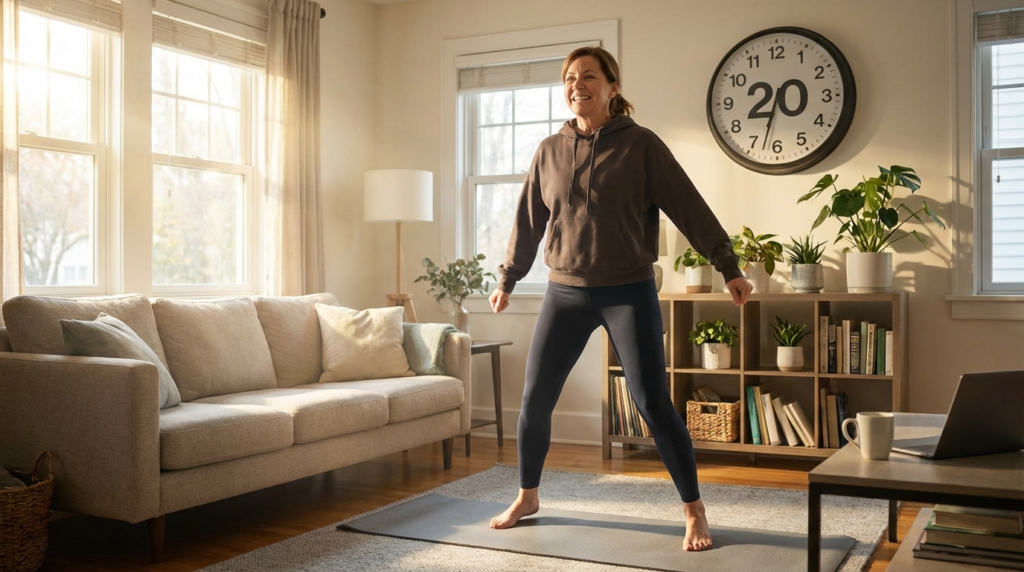
20 minute home workout for beginners at home
A 20 minute home workout for beginners is one of the smartest ways to get fit when life is busy.
You set your alarm for 6am with every intention of working out. Then life happened. The kids needed breakfast. Emails were piling up. And just like that — another day passed without exercise.
Sound familiar? You are not alone. Millions of people want to get fit but simply do not have the time.
Here is the good news. You do not need one hour. You do not even need 30 minutes. This simple 20 minute routine fits into even the busiest day — and it actually works.
This guide gives you everything you need. Four exercises. A clear structure. Zero equipment. And results you can feel within two weeks.
Ready? Let us begin.
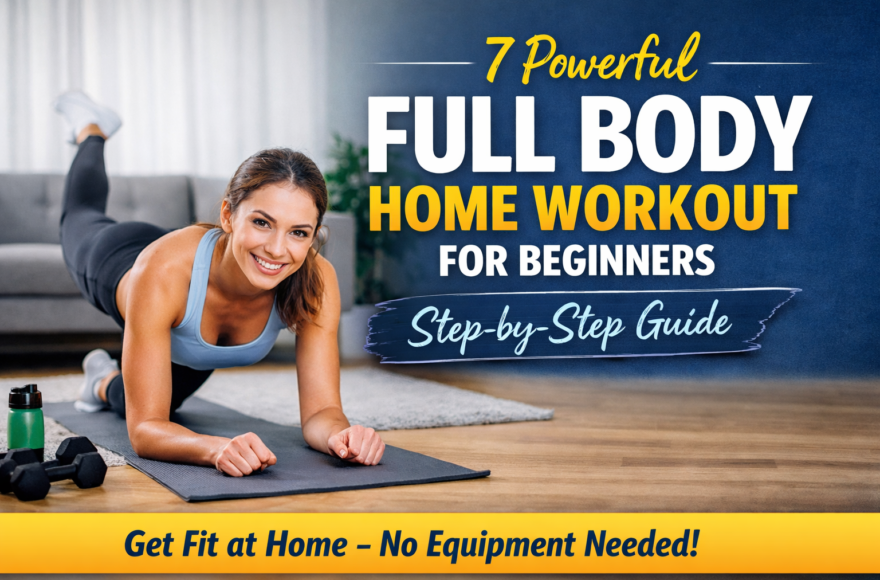
To see more workout routines read our guide to Full Body Home Workout Routine for Beginners.
Table Of Contents
- 20 Minute Home Workout for Beginners — Why It Works
- How This 20 Minute Home Workout for Beginners Is Structured
- Step 1 — Warm Up (3 Minutes)
- Step 2 — The Main Circuit (14 Minutes)
- Weekly Schedule for Your 20 Minute Home Workout for Beginners
- How to Make This Harder Over Time
- Five Tips to Stay Consistent When Life Gets Busy
- A Note for Those Who Want Extra Support
- Start Your 20 Minute Home Workout for Beginners Right Now
- FAQs
- References
When you are new to exercise your body responds to even small amounts of movement.
20 Minute Home Workout for Beginners — Why It Works
Your muscles are untrained. Your heart and lungs are not used to the effort. So just 20 minutes of focused work is genuinely enough to create real change.
Science backs this up. A study in the Journal of Physiology showed that short structured workouts produce the same fitness benefits as longer sessions for beginners.
The great thing about a 20 minute home workout for beginners is that it feels completely achievable. Twenty minutes is not scary. You will not talk yourself out of it. You will not skip it because you are tired.
And that consistency — showing up three times a week for just 20 minutes — is what creates real lasting results over time.
How This 20 Minute Home Workout For Beginners Is Structured
Every effective workout requires an easy-to-follow structure. This workout structure is quite simple to comprehend and remember as well.
The workout structure will be as follows:
✔ Minutes 0 to 3 – Warm up. Activate the body’s muscles and joints.
✔ Minutes 4 to 17 – Circuit session. The session includes 4 body-training exercises.
✔ Minutes 18 to 20 – Cool down. Slow down your pulse and do some stretching exercise.
The 20-minute exercise routine will include three circuit sessions that each take 4-5 minutes to complete.
Step 1 — Warm Up (3 Minutes)
Never miss the warm-up because your body has to be prepared properly for physical activities. This simple exercise will take only 3 minutes to prepare your muscles and joints for the upcoming workout.
✔ March in place (1 min)
✔ Arm circles (30 sec)
✔ Forward and backward
✔ Hip circles (30 sec)
✔ Forward and backward
✔ Hands should be placed on the hips
✔ Half squats (10 times)
✔ Only half-way movements
Step 2 — The Main Circuit (14 Minutes)
Perform each exercise listed below in sequence. There is a break between every move for about 20 seconds and one break after each circuit. You will need to repeat each of the moves 3 times before taking a minute break.
Move 1 — Bodyweight squat (40 sec — 20 sec rest)
It involves lowering your body into the sitting position, pushing back up using your heels, and squeezing your buttocks while standing. The squats are an effective exercise for beginners because they use major muscles of the body. Performing lots of squats will help you burn more calories even during resting time.
Too difficult? It is time to decrease the speed of your movements because you can take 3 seconds for going down and 1 second to return to the initial position.
Move 2 — Knee push-up (40 sec — 20 sec rest)
Firstly, you should kneel on the floor and put your hands wide apart from each other. Then, it will take you about 40 seconds to lower yourself to the floor and push yourself upwards with the elbows positioned at 45°.
It is normal if you can perform this exercise several times because you should not rush but focus on the quality of each repetition. Once you manage to perform a few knee push-ups, you can switch to full push-ups on your feet (within 2 to 3 weeks).
Move 3 — Glute bridge (40 sec — 20 sec rest)
Performing a glute bridge requires placing yourself in the supine position and lifting your butt up. While lowering it, you should make sure to control the movement and not drop the hips to the floor. Such an exercise will be particularly useful for people who sit all day long because this position strengthens glutes, which improves posture immediately.
Common mistake to avoid: Many people experience burning sensations in their lower backs while performing this move. To avoid such an unpleasant sensation, you should move your feet closer to your hips and squeeze the buttocks harder.
Move 4 — Plank (40 sec — 60 sec rest before repeating the circuit)
Performing the plank requires putting your body in the prone position with the use of forearms. Hands are placed on the floor with the elbows underneath your shoulders, and the legs should be spread. While performing the exercise, you need to maintain your body straightened with the help of the tight abdominal area.
It will take you 40 seconds to perform the exercise correctly while maintaining steady breathing. If you find it too difficult, you can start with 20 seconds and increase it gradually by 5 seconds each week.
The circuit looks like that: Squat (40 sec) → Push-up (40 sec) → Glute bridge (40 sec) → Plank (40 sec) → Break (60 sec) → Repeat 3 times. Finished.
Step 3 — Cool Down (3 Minutes)
It is as crucial to finish the session with cooldown as to warm up. Cool down is aimed at helping the heartbeat return to its normal state, avoiding muscle pain.
✔ Standing quad stretch (30 sec each leg)
Perform the move standing on one leg and holding the ankle with your hand
✔ Hamstring stretch (30 sec each leg)
Sit on the floor and try to bend your knee and touch your toes gently
✔ Child’s pose (1 min)
Kneel on the floor and put your hands forward while lying down
✔ Breath slowly (5 deep breaths)
Inhale deeply through your nose and exhale through your mouth
Weekly Schedule for Your 20 Minute Home Workout for Beginners
You can exercise for 20 minutes three times a week and achieve amazing results within two months. Such a schedule will give you a chance to relax and restore your body because your muscles grow when you rest. Have a look at the weekly plan described below and see how easy it is:
✔ Monday — Work out for 20 minutes
✔ Tuesday — Take rest
Or perform a 15-minute walk
✔ Wednesday — Work out for 20 minutes
✔ Thursday — Rest
✔ Friday — Work out for 20 minutes
✔ Saturday — Take a walk or stretch
✔ Sunday — Relax
Follow the plan strictly because your recovery is crucial for the development of muscles. Learn more about other weekly plans on the page of our 7-Day Beginner Home Workout Plan.
For a full day by day plan read our free 7 Day Beginner Home Workout Plan.
How to Make This Harder Over Time
Repeating the same routine regularly will not give you any result because your body adapts pretty fast. It is necessary to develop your muscles progressively and the 20-minute workout requires increasing workload and rest period. Find the tips on making the exercise routine tougher below:
✔ Weeks 1 and 2 — Follow the structure precisely
✔ Try to learn how to perform the moves properly
✔ Weeks 3 and 4 — Extend exercise time up to 45 seconds
✔ Weeks 5 and 6 — Shorten breaks between exercises to 15 seconds
✔ Weeks 7 and 8 — Repeat the cycle four times and perform 25-minute exercise
Such gradual changes in your routine will help you gain muscles faster. The technique known as “progressive overload” is the core principle of a 20-minute home workout.
Learn more about the workout from our full guide: How to Start Working Out at Home
Five Tips to Stay Consistent When Life Gets Busy
It is always hard to stay consistent while performing regular workouts. Luckily, we have prepared some tips for you to ensure the effectiveness of your 20-minutes home workouts:
- Put your workout clothes out the night before your routine. This will help you eliminate one excuse in the morning.
- Attach the workout to another process that you already have, such as drinking coffee after waking up.
- Set a reminder in your phone with a label “MY WORKOUT”. Get ready for the training as soon as your reminder buzzes.
- When life gets too busy, just perform one circuit and spend about 4 minutes for warming up and cooling down.
- Write down your exercises in a notebook (or in your mobile device) to follow your progress.
Not sure how often you should exercise? Read our simple guide on how often beginners should exercise.
A Note for Those Who Want Extra Support
For most people this 20 minute home workout for beginners combined with healthy eating produces excellent results. That is the honest truth.
But some people — especially those over 35 or those who have been inactive for a long time — find that their body responds more slowly. This is completely normal. It does not mean anything is wrong with you.
If that sounds like you one option worth knowing about is CitrusBurn. It uses plant-based ingredients like Seville Orange Peel Spanish Apple Vinegar and Himalayan Ginger to support the body’s natural metabolism.
It is not a shortcut. It works best alongside the exercise and healthy eating habits you are already building.
If you are curious you can learn more about CitrusBurn here.
Disclaimer: This section contains an affiliate link. If you purchase through it we may earn a small commission at no extra cost to you. Individual results will vary. Please speak to your doctor before starting any new supplement.
Start Your 20 Minute Home Workout for Beginners Right Now
This workout is totally free and ready to perform right away. Just read the article, know the plan, and start working out. Make a small area in your bedroom to practice. Perform warm up (3 minutes), then one round of the circuit (4-5 minutes) with 60 seconds of rest between them.
You will feel better in 20 minutes than right now. It is true and worth the effort!
Frequently Asked Questions
Is 20 minutes of exercise enough for beginners?
Yes, indeed. Being new to exercise, your body reacts well to the movements. Regularly performing the 20-minute home workout 3 times a week will help you strengthen muscles, boost your stamina and build a healthy habit. Consistency is the main thing!
Can I lose weight with a 20-minute home workout?
Absolutely. Losing weight involves burning calories with exercises and building muscles. Muscles consume more calories even when you do nothing. This workout for 20 minutes three times a week will help you burn plenty of calories and thus lose weight.
How many times a week should I do this exercise?
Performing the 20-minutes home workout three times a week is considered sufficient for beginners. It gives your body enough work for improvement and recovery. Too much is not always better, especially when you have just started to exercise. The optimal schedule has been recommended above.
Do I need equipment?
No, not at all. This program implies performing only bodyweight exercises. All you will need is an area of about a square meter in your bedroom where you will be practicing.
Can I work out for only 10 minutes when I am really busy?
Sure, it is better to exercise for 10 minutes than to skip this time. On such a day, you may consider completing one circuit with a warm up and cooldown.
Will I be sore after the workout?
Most likely, yes. This condition is called Delayed Onset Muscle Soreness and is completely normal. It occurs within 24 to 48 hours after your workout. The soreness is a symptom indicating that your muscles get stronger. Walking during your day off will accelerate the process of recovery.
How soon will I notice the effect of the 20-minutes workout?
Most people feel improvements during the second week after they start practicing regularly. It is easier to breathe and do anything else. The visible results come after 5-8 weeks of training. A full body transformation takes about 12 weeks. Be patient, results are coming.
What should I eat before/after the workout?
A light snack 30 minutes before training is a nice option if you feel hungry. For instance, a banana will do. After the training, you need to have your food with lots of proteins within 2 hours. Eggs, chicken, Greek yogurt, or lentils can be perfect for recovery.
References
- Gibala MJ et al — Short Intense Exercise Produces Same Benefits as Longer Workouts (Journal of Physiology 2012). URL: https://pubmed.ncbi.nlm.nih.gov/22289907/
- American College of Sports Medicine — ACSM Guidelines for Exercise Testing and Prescription.URL: https://acsm.org/education-resources/books/guidelines-exercise-testing-prescription/
- Garber CE et al — ACSM Position Stand How Much Exercise Do You Need (2011). URL: https://pubmed.ncbi.nlm.nih.gov/21694556/
- Schoenfeld BJ et al — Resistance Training Frequency and Muscle Growth (Sports Medicine 2016). URL: https://pubmed.ncbi.nlm.nih.gov/27102172/
- Lally P et al — How Long Does It Take to Form a Habit (European Journal of Social Psychology 2010) . URL: https://onlinelibrary.wiley.com/doi/abs/10.1002/ejsp.674
- CDC — Benefits of Physical Activity for Adults . URL: https://www.cdc.gov/physical-activity/php/about/index.html
- WHO — Physical Activity Fact Sheet (2020) . URL: https://www.who.int/news-room/fact-sheets/detail/physical-activity
- Stamatakis E et al — Short Vigorous Activity and Mortality Risk (European Heart Journal 2022) . URL: https://academic.oup.com/eurheartj/article/43/46/4801/6771381
Disclaimer: This article is for information and education only. It is not medical advice. Please speak to your doctor before starting any new exercise or supplement programme especially if you have an existing health condition. Some links in this article may be affiliate links. If you purchase through them we may earn a small commission at no extra cost to you. We only recommend things we genuinely believe can help you.